MagentaGaming Cloud Gaming Platform
Deutsche Telekom AG (Product Innovation)2020–2021
Team: 25 peopleProduct Owner & System Architect
Overview
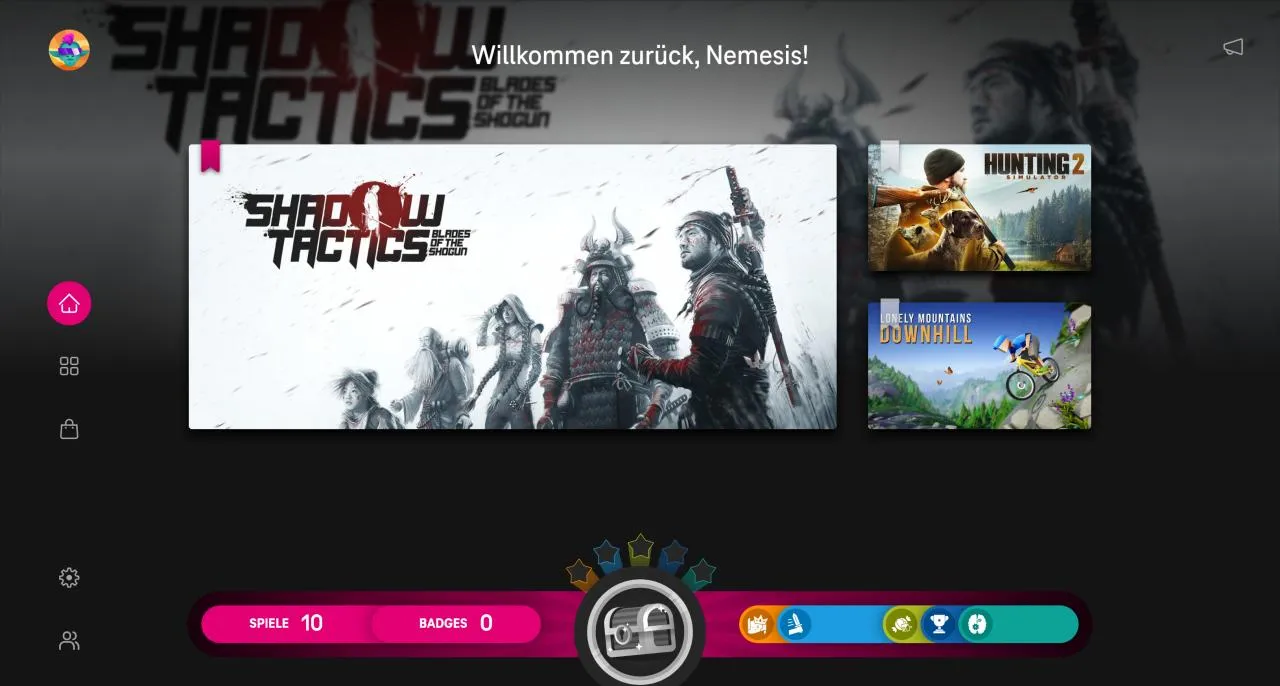
MagentaGaming was Deutsche Telekom's cloud gaming product, delivering AAA titles to Browser, Android, Windows, macOS and Android TV without local gaming hardware. The games ran on NVIDIA servers inside Deutsche Telekom's fixed-line network, integrated through a Qt-based C library by a Polish delivery partner. My team built the WebView application layer and the entire cloud platform around it: account management, frontends, billing, friend lists and leaderboards.
I owned the project from February 2020 to October 2021, formally as an employee of Deutsche Telekom AG (Product Innovation). At launch my team was 25 people strong, 90% of them Romanian external consultants from Endava: frontend, backend, test automation, DevOps and SREs. We worked under SAFe.
Challenge
The defining constraint was the Gamescom deadline. Deutsche Telekom had committed publicly to a launch at the (covid-driven all-digital) Gamescom 2020, with press and partner announcements already lined up. Six months of build time, then live in front of cameras.
The bigger technical hurdle was integration. Telekom IT landscapes are complex for good reasons, and the established core systems for accounts, ordering and billing were never designed for cloud-native consumers. We had to plug a modern serverless platform into a corporate IT landscape that some considered legacy, without blocking the delivery capacity on the other side.
Functionally the scope was wide: account creation, tariff binding, game library, friend lists, co-op play, statistics, leaderboards, billing. Every feature came with its own stakeholders who wanted to be heard inside an MVP sprint rhythm.
The streaming server and latency topics for the games themselves sat outside my remit. The game infrastructure ran on-premises inside the Deutsche Telekom backbone with path optimisation in the network layer.
Role
I was Product Owner for the cloud development team and held the System Architect role in parallel. On top of that I:
- Drove the procurement specification for the external delivery organisation
- Ran security reviews ahead of every release
- Maintained the platform documentation and release notes
- Coordinated the release schedule into the Gamescom slot
My direct accountability spanned the entire cloud platform underneath the game stream: account lifecycle, billing, frontend, backend APIs, CI/CD and observability.
Process
I laid the platform out as serverless from day one. ECS Fargate for stateless microservices, Lambda for event-driven logic, Aurora PostgreSQL for transactional data, DynamoDB for high-frequency state like sessions and leaderboards, Step Functions for workflows like account creation and billing. API Gateway plus an Application Load Balancer formed the edge, CloudFront sat in front of static assets.
The security baseline was active from the start: Security Hub, GuardDuty, CloudTrail, Inspector, KMS CMKs, VPC with private subnets for the ECS tasks. CodeBuild and CodePipeline pushed container images to ECR, Terraform managed the entire infrastructure. The platform ran fully in eu-central-1.
The device frontends talked to the same API layer. The Polish delivery partner RemoteMyApp (RMA) provided the Qt-based C library for game integration. My team built the WebViews and the application logic so game servers and platform could evolve independently.
Decisions
Serverless over classic Telekom IT stacks. A conventional EC2 or on-prem architecture would not have hit the deadline. Lambda, Fargate and managed services delivered the velocity we needed and saved the patching and ops work a 25-person team could not absorb.
WebView pattern for cross-platform UI. The same UI codebase ran on Browser, Android, Windows, macOS and Android TV. The frontend team built every feature once instead of porting it five times.
Game servers stayed on-premises. Latency requirements were easier to meet through the Deutsche Telekom backbone and its path optimisation than through cloud GPU instances in a single region. That decision sat outside my mandate. The platform was cut so both worlds cooperated cleanly.
Results
- MVP built in six months, from kickoff in late February 2020 to live launch on 23 August 2020 at the digital Gamescom
- 100 titles available at launch
- More than 200 concurrent gaming sessions at peak
- Around 40 ms glass-to-glass latency for end customers
- 5 device platforms sharing a single UI codebase: Browser, Android, Windows, macOS, Android TV
- No availability incidents during the launch window
- Cloud platform fully operated in eu-central-1 under group-level data protection rules
The fixed Gamescom deadline acted as a forcing function for scope and architectural discipline. Deutsche Telekom retired the service in early 2023 after roughly two years. Until then, the architectural decisions carried the operation without a structural rebuild.